A Glad Reversing
A reflection upon the hymn "Easter Greeting"

Easter Greeting is a hymn recorded by Indelible Grace Music featuring Michelle Raybourn and Mikey Rogers. It will be included on our “Rove No More: Indelible Grace VIII” project releasing on May 1, 2026, but is out as a single everywhere already.
You can listen to our recording on your favorite streaming service here
And you can watch this lyric video below
In looking for hymns for our Indelible Grace1 projects I typically look for texts that contribute in a meaningful way to the songs we have in regular use today. So, I especially look for texts that cover topics which are underrepresented by other worship songs, or texts which say something in a fresh and striking way. This hymn text does both and I am so glad that Michelle and Mikey pressed me to record this one! (True confession, their original demo was 8 minutes long - and so we sped it up a bit, and cut two verses of their text. But you can find the lead sheet and chord chart - including the extra verses - at the Indelible Grace Hymnbook website here)
Here is the text as Mikey and Michelle sang it on our recording:
1. Faithful women sought Him weeping,
Weeping at the break of dawn, -
Sought their Lord where He lay sleeping,
In the love of hearts forlorn.
Life for death that wondrous morning
Joy for sorrow, faith for fear,
For their tears the Angel’s greeting,-
Christ is risen! He is not here.
2. Loved Apostles, scarce believing
In His triumph o’er the grave,
Hear the tale amid their grieving,
Hasten eager to the Cave;
Find the folded graveclothes lying,
Death’s unloosed and shattered chain,
Find Him gone, death’s power defying,
From the tomb thus sealed in vain.
Christ is risen! risen, sister!
Brother, Christ is risen indeed!
3. Mary comes, a refuge seeking
For her mourning and her pain
Lo! a well-known voice is speaking
Lo! the Master calls her name
For her grief, a glad reunion,
Living Teacher, dear reward
For her tears the glorious mission
To announce the Risen Lord
4. For her tears, a glad reversing
Of the tragedy of old
Glorious tidings now rehearsing
For the tale in Eden told
Woman’s voice, that tale supplying
Brought in death by Satan’s lie
Woman’s voice is now replying
Christ is risen! We shall not die
Christ is risen! risen, sister!
Brother, Christ is risen indeed!
5. Saints, your Cross in patience bearing
Mourners stained with many tears
Sinners, tempted to despairing
Everyone is welcome here
Christ is risen! bring your sadness
Come and join the joyous throng
Faithful hearts will find their gladness
Joining in the Easter song
Christ is risen! risen, sister!
Brother, Christ is risen indeed!
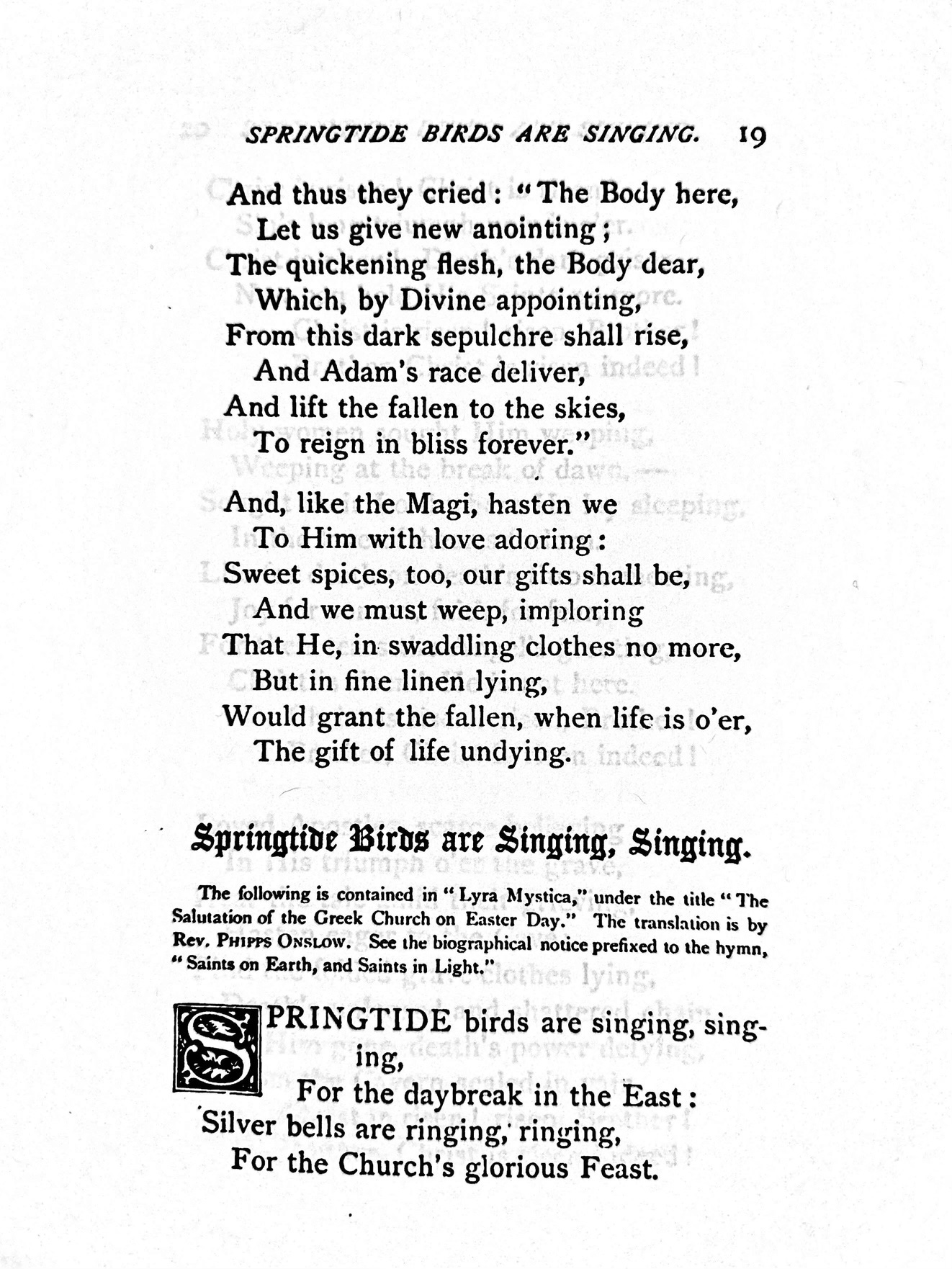
The text comes from an ancient Greek hymn translated in the 19th century by Englishman Phipps Onslow (could there be a more English name than that?) The first line in his full version is “Springtime birds are singing, singing” and I have posted a pdf scan of the full original text.
We came upon the text by way of my friend Bruce Benedict, who shared the Resurgit Hymnal a few years ago while encouraging songwriters to contribute to a Cardiphonia Resurrection project which you can find here

I would like to draw your attention to the way in which poetic justice highlighted throughout this text, typically by the use of the word “for.” I know that “poetic justice” often has the negative connotation of a punishment that fits the crime - and if there is a more fitting term I would love to know - however one of the things I love about this hymn is the way it highlights the poetic resolution through the events of the Easter story. Phipps Onslow (the translator of the text) uses the phrase “a glad reversing” in verse four and that captures it well. Put simply, the events we celebrate in the Easter story are full of glad reversals. Of course, the archetype is the resurrection, the triumph of life over death. But this text revels in the glad reversals throughout the story. We see this in verse 1, “life for death that wondrous morning, joy for sorrow, faith for fear.” I love that in every one of these “pairs” the gain is greater than the loss! It reminds me of Isaac Watts’ famous line (speaking of the “fortunate fall”) in his hymn “Jesus Shall Reign Wher’er The Sun”, “In Him the tribes of Adam boast, more blessings than their father lost.” Truly to be in union with Christ means that “blessings abound” as Watts says earlier in the hymn!
That is what we see in the first verse of Easter Greeting. Joy is not merely the absence of sorrow, faith is not just the absence of fear. No! joy and faith are abundantly more than the sorrow and fear they drive away. We see this even more pointedly in the last lines of verse 1, “For their tears, the Angel’s greeting, “Christ is risen! He is not here!” The announcement that Christ is risen is infinitely more than a mere answer to their tears. There is a poetic justice response to their tears - a response that is fitting - but the response is so much greater than merely meeting them in their grief. We need a better term for this than “poetic justice.” Perhaps poetic consummation? - if by consummation we think of a kind of exuberant fittingness. (Please let me know if there is a better term for this idea.)
I think the apostle Paul felt something of the inadequacy of words when he begins to compare Adam and Christ in Romans 5. As soon as he hears himself begin to make the comparison of the one act of disobedience of Adam to the one act of obedience by Christ in Romans 5:12, he stops short! He doesn’t resume the comparison until verse 18 because he feels compelled to explain all the ways those two things are NOT the same before he can even go on with his argument! There is something like that in verse 1, comparing their griefs with the Angel’s greeting. The proclamation, “Christ is risen” doesn’t just drive away their grief, it changes everything, and in ways that could never have been imagined. Exuberant consummation I contend.
We see this same thing in verse 3. Mary comes, looking for a refuge for her tears and pain. But instead she receives a shock - Lo! Look! Behold! Lo! is repeated twice to help us feel the stunning surprise. The poet evokes the image of blinking your eyes twice to ensure you are actually seeing what you are seeing, “Lo! a well-known voice is speaking” begins the build toward increased realization of what is happening, culminating in“Lo! the Master calls her name.” The Master calls her name. Every word in that sentence preaches a sermon - especially when you recall the story of Mary Magdalene. And she is entrusted with a glorious mission! “For her grief a glad reunion… for her tears, the glorious mission, to announce the Risen Lord!” One of the oft-overlooked beauties in the gospel accounts is the way women, regarded as inadequate witnesses in the first century context, are dignified by being the first witnesses to the resurrection. The important honor given to the women in this hymn is one of the things that drew Michelle and Mikey to this text. It is also why they included brother and sister in the refrain as the whole body of Christ is called and honored to be able to share this good news.
It is verse four though that is my favorite part of this hymn. Now, I do not intend in this essay to defend my view of the role of women in ministry and the relevance (or not) of the interpretation of 1Timothy 2:12.2 But I have always been intrigued by the argument Paul3 makes in verse 13-15 as a great example of the kind of poetic justice I see emphasized throughout this hymn. Paul is arguing that there was an order of things set up in the creation, which was tragically reversed. At the very least he is saying that Adam was created first, but Eve took the “lead” if you will, and through this (he does not say because of this) sin came into the world. Some have seen Paul’s statement that Adam was not deceived (vs. 14) as implying that Eve was more gullible. I actually see it differently, Adam wasn’t deceived and this perhaps makes his sin even more heinous. (Speculative I know, but I think it is an interesting possibility.) But 1Tim 2:15 is the most intriguing verse, and in my work with college students often the most potentially offensive. As been pointed out by numerous commentators, childbearing in the Greek is a participle with a definite article and thus could be rendered “the childbirth.” Isn’t it interesting that an early Greek hymn (the basis for Phipps Onslow’s translation here) seems to take it this way. What is the significance of this rendering?
If you take 1Timothy 2:15 to be a reference to THE childbirth through which redemption would come then you have a powerful example of poetic justice. Rather than arguing that women are more gullible and easily deceived, Paul is simply saying the lies came through the woman Eve first, but the Messiah would come through a woman as well. Perhaps some of you have seen the painting Mary Comforts Eve.4 I believe it is a powerful expression of the poetic justice, or redemptive story ark Paul is alluding to in 1Timothy 2:15 with regard to the role of women in the Biblical storyline. Allow me to quote verse 4 again here:
4. For her tears, a glad reversing
Of the tragedy of old
Glorious tidings now rehearsing
For the tale in Eden told
Woman’s voice, that tale supplying
Brought in death by Satan’s lie
Woman’s voice is now replying
Christ is risen! We shall not die
There is that phrase “a glad reversing” of the tragedy of old. The Easter story we retell every year is glad reversing of another tragic story in which a woman also played a significant leading role. How beautiful that God would not only redeem His people through the death and resurrection of His Son, but would also bring a glad reversal to the corporate shame (if you will) of women for the role in the garden by another garden scene in which women are called to announce the good news of the resurrection! It is worth pondering I think.
One of the things that hymns can help us do is to slow down. I believe that artists do not just express things differently; they see things differently. They notice things and can teach us to slow down and attend to things more as well. If faith is seeing more not less, opening our eyes to all of reality rather than putting blinders on and only seeing the pretty parts of life, then slowing down to contemplate a hymn text like this can be a rich exercise. I invite you to it.
One more thing, a suggestion for those who might want to use this hymn in a corporate worship setting. We debuted this hymn with our students earlier this week and I saw how the recording brought a bit of confusion to those leading the singing. In the recording, Michelle and Mikey alternate between each other in singing the melody and harmony parts - and the arrangement evolves to have them singing different harmonies later in the song than they do at the beginning. I would suggest not trying to duplicate that for corporate worship because it is hard to teach and explain. My suggestion is to keep the main voice on the melody and build other harmony parts from there. It is similar to what we did in our recording of Psalm 130 (From The Depths Of Woe) where the male and female parts sort of stair step up in harmonies as the song progresses. When I lead that one we have one male and one female do the respective main parts in the same register throughout, and add other harmony voices on top of that to build the song.
I hope this helps!
Grace and peace, Rev. Kevin Twit
Indelible Grace Music is a collective of artists which I began with some of my friends and former Belmont RUF students in the late 1990s. We released our first CD in 2000 and have went on to release over ten albums of “retuned hymns” and maintain an Instagram account and the Indelible Grace Hymnbook website which has charts and lead sheets for free download here
I am not afraid of the discussion, but this is not the place for it - I think that discussion is better in person than online with the extra difficulty of expressing tone and nuance.
I take the view that Paul is the author of the pastoral epistles